
By Shabaz Kazia
He rubs his chin, smiles and kicks his right heel against the classroom floor as he deep dives into his memories of growing up on his family’s Chinese vegetable farm in Woodland, California. As he recounts his childhood for an
SF State reporting class, he remembers that even before becoming a journalist he knew race would be a lasting factor.
“I grew up in a rural area and the demographics were 60 percent white, 30 percent Latino and 10 percent everything else,” he says. “So, you know, I was sort of cognizant that, oh yeah, you’re made to feel different in subtle and not so subtle ways growing up in an area like that.”
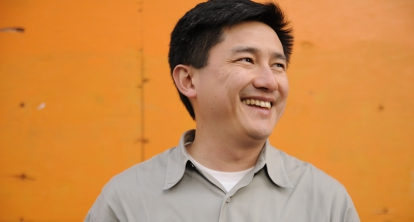
Journalist, copy editor and Chinese American Harry Mok, 48, has an extensive career in journalism writing about the Asian American experience, stemming from struggles he experienced in his rural beginnings.
“I realized [while] living in rural California that I was in one of the few Asian American families in town and you know, it felt different,” says Mok. “I kind of had that awareness that race was an issue so those were the things I wanted to pursue as well in journalism.”
Mok addressed the classroom of aspiring faces, which has a diverse palette of races and genders, about being a minority and a journalist. He said he remembers being pinned with stereotypes at a young age when he was sent to the nurse’s office due to a dislocated thumb while playing softball. The doctor did not think an anesthetic was necessary as Mok would not complain since he was Asian.
Aya Yoshida, a 21-year-old journalism major, listens with attention as Mok discusses his experience as an Asian American journalist.
“I’m familiar with the Asian American community,” says Yoshida. “So just like him, I want to cover minorities or Asian Americans.”
Covering Asian American stories is a driving factor for Mok. His involvement in various projects that focus on Asian Americans cements that.
As an editor-in-chief and writer for Hyphen Magazine between 2004 to 2011, a volunteer-run Asian American magazine, he penned stories that ran the gamut from Asian pornstars struggling to break stereotypes to Gene Roddenberry’s complex vision of diversity in the future within the Star Trek franchise.
“I think it was because you’ll see Asian Americans or African Americans hyphenated,” says Mok about the origin of Hyphen Magazine’s name. “It was about taking back the hyphen and a lot of people don’t use the hyphen because it sort of denotes a second class citizen or status.”
In his second article for Hyphen Magazine in 2003, Mok gets personal about his childhood. “I spent my youth picking gai-lan and yu choy, pulling weeds and digging irrigation trenches,” he writes. “We found our path to the American dream – in the dirt.”
American River University is where Mok’s journalism education began, followed by San Jose State University where he earned a Bachelor’s in Journalism with a minor in Asian American Studies. He finished off his studies in UC Berkeley’s Journalism Graduate program. Mok jokingly tells the classroom to not pursue three degrees in Journalism.
Mok highlights that one of his fondest projects as a journalist came from was when he was at Berkeley. It was titled “Finding Roots in China’s Soil / Chinese Americans from the Bay Area visit the villages of their ancestors in genealogy program” and was later published at the SF Chronicle. He worked with a genealogy program for about a year called Roots, that sent Chinese Americans from the Bay Area to China who were between the ages of 16 to 30 and had roots in Pearl River Delta of Guangdong, which surrounds Hong Kong.
Mok’s journalism career has been much of a proving grounds for not just being a journalist, but also an Asian American. He cautions the intimate crowd of future journalists that racism exists in all places, even in places where one wouldn’t expect.
“You can encounter racism anywhere, even here in San Francisco,” says Mok. “You think this place is so diverse and all that, but there’s racism here too.”
The subtle experience in his journalistic career speaks in a testament to that. Mok recounts his past experiences of subtle racism working at The San Francisco Chronicle, where he would be mistaken for his Asian colleagues.
“[It was] nothing overt, but what would happen is…I would be called Markus sometimes because we worked in the same department and I even got Benny once,” says Mok. “It falls into that stereotype of ‘all Asians look alike.’ This is in a newsroom with supposedly very open-minded people, so it’s not just in rural areas that things like that can happen. It hasn’t happened at my second time around in The Chronicle, so we’ll see.”
A 2016 American Society of News Editors survey found that minority journalists represent 17 percent of the workforce in newsrooms.
Race representation is an ever-present issue in the media and something Mok discusses in his writing. His frustration has been mirrored by last year’s controversy over the Oscars being too white. Minorities can be underrepresented in media, which renders a whole group invisible.
“Invisibility is a good example,” says Mok about Asian American representation. “Hollywood movies tend to take original stories where maybe the characters are Asian and cast white actors in them or non-Asians, and that happens over and over again. So, things like that sorta say the Asian American communities are kinda invisible or don’t matter. Those are themes that I see over and over again.”
Actors like Constance Wu, the matriarch in the ABC sitcom Fresh off the Boat, echo Mok’s sentiments and have been outspoken about the adversity in Hollywood that often whitewashes ethnic roles and promotes white savior movies, like last year’s Doctor Strange.
As a member of the Asian American Journalist Association’s Media Watch Committee, Mok monitors news coverage of the Asian American community. He helps the AAJA craft statements if something is offensive or coverage is inaccurate.
“One of the things I’m sort of interested in is making sure that the coverage of, not just the Asian American community, but minority communities or the sort of communities that aren’t generally covered, that those things are being covered accurately and that they’re being covered at all,” says Mok.
 Shabaz Kazia